 TradaZen

Tilt in trading is the state where a loss, or a streak of losses, pushes you off your plan, so you trade on emotion instead of your method. Willpower alone won't stop it. You need to spot the signs that come before it and follow rules you set with a cool head, before the session, that make you stop in time.
The 7 signs that should alert you:
- You increase your position size right after a loss.
- You take an entry that doesn't meet your criteria.
- You move or remove your stop "to give it room to breathe."
- You take trades faster than usual.
- You trade outside your usual hours, late at night after a bad day.
- You think "I have to win it back."
- You stop logging your trades, because you don't want to look at them.
This article is about discipline and psychology. It is not investment advice: trading carries a high risk of capital loss.
What is tilt in trading?
The word comes from poker, where it describes a player who starts playing recklessly after losing a hand. In trading, it works the same way. A loss sets off a strong emotion (frustration, anger, a need for revenge), and that emotion takes the place of the plan.
Tilt is not a character flaw. It is a human reaction to loss, and because it follows a pattern, you can learn to spot it.
The 7 signs of tilt, explained
1. Increasing size after a loss. The thought "I'll get it back faster if I bet more" is the exact opposite of what discipline asks of you. When your confidence is shaken, that's not the time to take on more exposure.
2. An entry outside the plan. You set your criteria in the morning, with a cool head. An entry that ignores them is almost always an emotional one, even if it ends up winning. And an off-plan entry that wins is dangerous, because it makes you want to do it again.
3. The stop that moves. Moving your stop to avoid taking a loss means refusing to admit you were wrong. It also turns a small, planned loss into a bigger, unplanned one.
4. Speeding up. You jump from one trade to the next without a break, trying to erase the last loss. The pace itself is a signal.
5. Hours that drift. Sitting back down in front of the charts late at night after a bad day is a warning sign on its own, whatever the trade that follows.
6. The language of revenge. "I need to get that back": your decision is driven by a past loss, not by a present opportunity.
7. The abandoned journal. When you stop logging your trades, it's often because you don't want to look at what you're doing. That is exactly when you should.
Why is tilt so hard to see in the moment?
Because the perspective you need most is exactly what's missing at that moment. A loss triggers a real emotional reaction, and you'd have to analyze the situation calmly right in the middle of it. It is very hard to judge your own state while you're in it.
That's why the solution can't be purely mental, along the lines of "I'll talk myself out of it." It has to rely on external markers, decided before the session, that apply without asking your opinion at the moment your judgment is weakest.
Tilt vs. revenge trading: what's the difference?
Revenge trading is the most common form of tilt: jumping back into a position right after a loss to "win it back." Tilt is the emotional state; revenge trading is the action it triggers. You fight both the same way: a mandatory break after every loss, a position size that doesn't change during the session, and a loss limit set with a cool head.
What do the numbers say about retail trading?
In 2014, the Autorité des marchés financiers (AMF), the French market regulator, published a study of the results of retail investors trading CFDs and Forex. Of 14,799 active clients observed over four years, more than 89% were losing.
Two findings from this study are worth knowing. First, the retail traders who placed the most orders, or the largest ones, lost the most. Second, those who kept going over time did no better, which the AMF describes as an absence of any learning effect.
The study doesn't measure tilt as such. But it is a useful reminder of two things: trading more doesn't mean trading better, and experience alone doesn't protect you from losses. Never risk money you need.
How do you stop tilt in trading?
A mechanical rule beats a good intention, because it doesn't ask you to judge your situation when your judgment is impaired. Here are examples of rules to set in writing, with a cool head, before the session. They are behavioral guardrails, not investment recommendations: adapt them to yourself.
- A loss limit per session. Past a number of consecutive losses or an amount set in advance, you stop for the day. No negotiating.
- A mandatory break after every loss. A few minutes away from the screen before you can open another position.
- A position size set before the session, which never changes during the session.
- A written plan: what you're looking for, where you enter, where you exit. If the entry isn't in the plan, you don't take it.
- A journal kept in the moment, noting after each trade whether you stuck to your plan or not.
That last point deserves a closer look. On its own, a single note doesn't say much. Built up over several weeks, your notes show when your decisions go off track. We lay out a simple method in our article on the trading journal.
Practice making decisions without real money
Another way to work on your discipline is to practice making decisions on real charts without risking any money. That's the idea behind the TradaZen trading simulator.
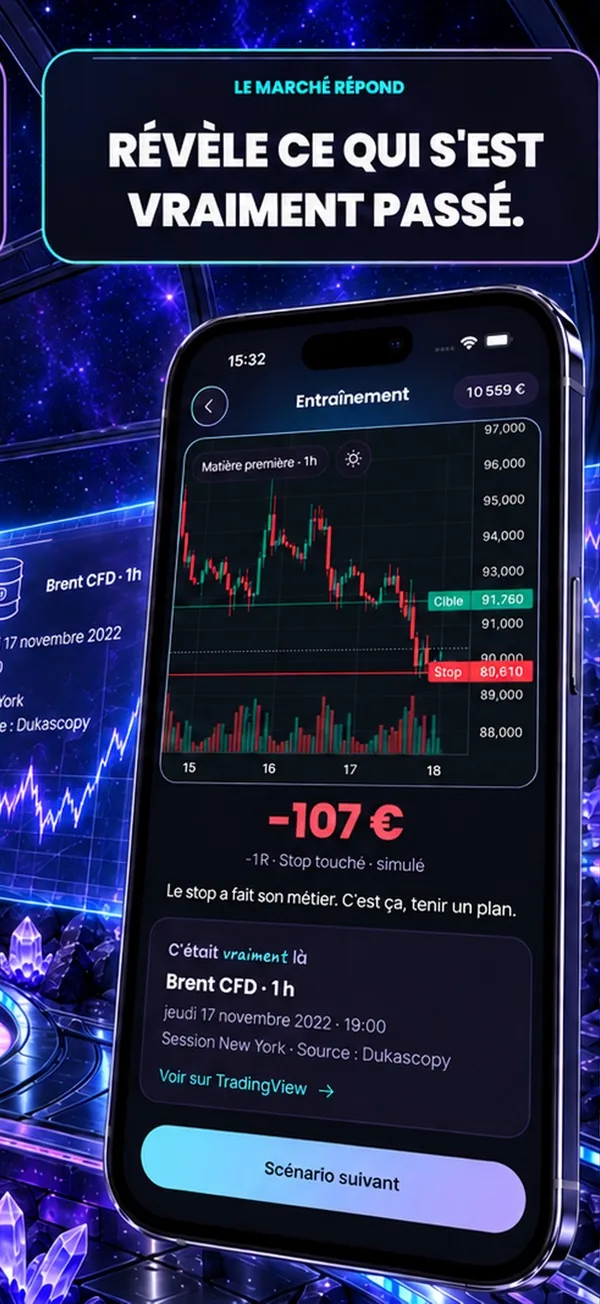
The app shows you a real chart at a real date, with what came next hidden. You choose Long or Short, then the candles are revealed up to the stop or the target. The account is simulated, and it grows with your good reads. You can also face other players in ten-round ranked duels and track your progress on a rank that goes from Iron to Diamond. A journal rounds out the training.
Let's be clear about its limits. A simulator doesn't fully reproduce the emotion of real money, and a good read on a past chart says nothing about a future result. TradaZen places no orders, doesn't manage your money and gives no investment advice. It's a training ground for your method and your discipline, not a promise of gains.
 Mehdi Azizi created TradaZen and published it on the App Store through the Devoria studio. The app's scenarios are real past charts, never made-up data.
TradaZen is a training tool: you play on past market data with a simulated balance. It is not a broker and not investment advice. Real trading carries a risk of capital loss.