 TradaZen

In 20 seconds
- Definition
- The ratio between the position size and the stake set aside, the margin.
- Calculation
- Position = stake × leverage. Drop that wipes out the stake = 100% ÷ leverage.
- Example
- €100 stake at 20x leverage: a €2,000 position, wiped out by a 5% drop.
- Caps in Europe
- For CFDs sold to retail clients: from 30 on major currency pairs to 2 on crypto-assets.
- Trap
- Starting from the stake instead of the stop: liquidation then becomes your stop.
Leverage gives you more exposure than the money you commit. You put down a stake, the margin, and the intermediary lets you open a position several times larger. Your result is calculated on the whole position: a small price move becomes a large move in your account, in both directions.
This guide describes a training method, not investment advice. Trading carries a high risk of capital loss. With leverage, the loss on a trade can exceed the stake committed to it.
The calculation
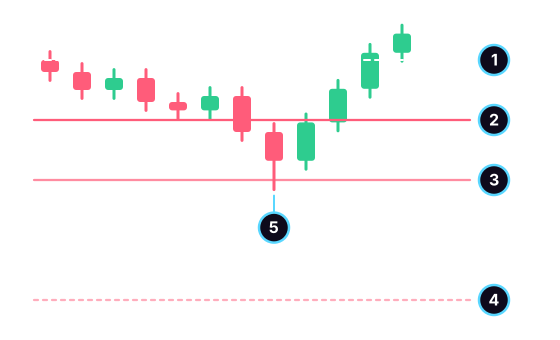
- The entry, on a buy.
- The threshold that wipes out the stake at 20x leverage: 5% below the entry.
- The 10x leverage threshold: 10% below the entry.
- The 5x leverage threshold: 20% below the entry.
- A wick that crosses the first two thresholds. The price ends above the entry, but the 10x and 20x positions have already been closed.
Three formulas: position = stake × leverage, result = price change × position, and drop that wipes out the stake = 100% ÷ leverage.
| Leverage | Position for a €100 stake | Drop that wipes out the stake |
|---|---|---|
| 2 | €200 | 50% |
| 5 | €500 | 20% |
| 10 | €1,000 | 10% |
| 20 | €2,000 | 5% |
Example: €100 stake, 10x leverage, buy at 50,000. Your position is worth €1,000. A 2% drop costs you €20, which is 20% of your stake. At 45,000, 10% lower, the €100 is gone. Leverage also magnifies rises, in the same proportions.
Margin, margin call and liquidation
Margin is the money the intermediary sets aside to secure your position: the position size divided by the leverage. When your losses eat into it, the intermediary asks you to add more (the margin call) or closes the position by force. This forced closure is called liquidation.
It usually happens before the whole stake is lost, because the intermediary requires a minimum margin to keep the position open. The 100% ÷ leverage thresholds are therefore a best case.
In Europe, for CFDs sold to retail clients, positions are closed when the account margin falls to 50% of the required minimum, and the account balance cannot go negative. So a trade can lose more than its own margin, but not more than the account.
Leverage caps for retail clients in Europe
On March 27, 2018, the European Securities and Markets Authority (ESMA) capped the leverage on CFDs sold to retail clients, according to the underlying asset:
| CFD underlying | Maximum leverage |
|---|---|
| Major currency pairs | 30 |
| Other currency pairs | 20 |
| Gold | 20 |
| Major stock indices | 20 |
| Commodities other than gold | 10 |
| Minor indices | 10 |
| Shares and others | 5 |
| Crypto-assets | 2 |
In France, the Autorité des marchés financiers (AMF), the French market regulator, made this measure permanent from August 1, 2019: leverage limits, closing of positions per account, no negative balance, risk warning.
Platforms not authorized in France offer much higher leverage: the AMF publishes their names on its blacklists.
What 5 years of Bitcoin show
For each candle, I imagined a buy at its close, with no reading at all, at 2x, 5x, 10x or 20x leverage. Then I counted the cases where a wick reached the threshold that wipes out the stake within the following day, week or month.
| Leverage | Drop that wipes out the stake | Within 1 day | Within 7 days | Within 30 days |
|---|---|---|---|---|
| 2 | 50% | 0% | 0% | 0% |
| 5 | 20% | 0.1% | 3.7% | 17.6% |
| 10 | 10% | 1.8% | 17.2% | 46.9% |
| 20 | 5% | 10.1% | 44% | 71.3% |
Method: BTC/USDT, 4-hour candles, public Binance data, entries from January 2021 to December 2025, so 10,676 buys each tracked over 30 days. No fees, no funding, no minimum margin, no stop. 95% margin of error: less than one point. Past data: it does not predict the future.
At 20x leverage, one buy in ten lost its entire stake within the day, and nearly one in two within the week. At 10x leverage, nearly one in two within the month. 2x leverage never wiped out a buy within 30 days over this period.
These entries overlap: a single crash counts for every candle before it, and the real margin of error is larger than one point. At 20x leverage, at least one buy lost its entire stake within seven days in 59 of the 60 months studied.
At the median, the worst drop a buy went through was 1.5% within the day, 4.3% within the week and 9.2% within the month. At 10x leverage, the 10% threshold is barely further away than this ordinary drop.
For sells, the figures are similar: 9.9%, 45.5% and 76.5% at 20x leverage. Over 30 days, even 2x leverage wiped out 2.6% of sells, because the price rose 50% in less than a month in 2021 and in 2024.
The ESMA closing rule closes the position earlier, at half the stake if the account holds only that margin. At 2x leverage, the cap for crypto-asset CFDs, a 25% drop is then enough: 9.7% of buys would have gone through it within 30 days.
Start from the stop, not from the leverage
Your risk is set by the stop and the position size. Leverage only serves to make that size possible.
Example with the 1% rule: €10,000 account, €100 of risk. Stop 2% below the entry: €5,000 position, no leverage needed. Stop at 0.5%: €20,000 position, which is 2x leverage on the account. If the stop is hit, you lose €100 in both cases.
- Place your stop loss where your idea is proven wrong.
- Calculate your size: amount at risk ÷ stop distance.
- Work out the leverage you need: position size ÷ account capital.
- Check the liquidation threshold. It must sit well beyond your stop, funding fees included.
Common mistakes
- Thinking in terms of the stake: "I'm only risking €100." At 20x leverage, that €100 disappears on a 5% drop.
- Taking the maximum leverage because it's offered. The cap is a legal limit. Nothing forces you to go anywhere near it.
- Trading without a stop. Liquidation becomes your stop, and it's the worst placed one: it depends on your stake, not on the chart.
- Raising leverage to win it back, one of the signs of tilt. In the AMF study, the largest orders, leverage included, had the largest losses.
Practice calculating your size
In TradaZen, the "Position size" unit teaches you to calculate the size that puts exactly 1% of the account at stake, stop included. The app menu also has a "Position size" tool that calculates your size for 1 R.
In Training, after you choose Long or Short, the app places the Stop and the Target, and shows what you are putting at stake. If the price already opens beyond the Stop, the exit happens at the open, and the loss exceeds 1 R, on a simulated balance. To learn more, read the page on the trading simulator.
A simulator has its limits. It doesn't fully reproduce the emotion of real money, and a good reading on a past chart says nothing about a future result. TradaZen places no orders, doesn't manage your money and gives no investment advice.
Frequently asked questions
How do you calculate leverage?
Divide your position size by the stake you commit: a €1,000 position for €100 of margin is 10x leverage. The drop that wipes out the stake equals 100% divided by the leverage, so 10% at 10x leverage and 5% at 20x.
What is the maximum leverage allowed in Europe?
For CFDs sold to retail clients, ESMA set caps in 2018 ranging from 30 for major currency pairs to 2 for crypto-assets. The AMF has applied them permanently in France since August 1, 2019.
Can you lose more than your stake with leverage?
On a single trade, yes: the loss can exceed that position's margin and eat into the rest of the account. For CFDs sold to retail clients in Europe, the account balance cannot go negative. For Forex outside this framework, the AMF points out that losses can exceed the amount invested.
What leverage should a beginner use?
No single number fits everyone: leverage is not the first thing you choose. Place your stop, calculate your size from your risk per trade, and the leverage follows. To learn, a simulated balance is enough, with no leverage.
 Mehdi Azizi created TradaZen and published it on the App Store through the Devoria studio. The app's scenarios are real past charts, never made-up data.
TradaZen is a training tool: you play on past market data with a simulated balance. It is not a broker and not investment advice. Real trading carries a risk of capital loss.