 TradaZen

In 20 seconds
- AMF, 2014
- 89.4% of clients lost money over four years, with an average loss of €10,887 per client.
- ESMA, 2018
- Between 74 and 89% of retail accounts lose money trading CFDs.
- The measured causes
- More orders, bigger orders, more years of trading: each time, heavier losses.
- What you control
- Your risk per trade, your position size, your number of orders and your journal.
You often hear that almost all retail traders lose money. The exact figure exists: it comes from a study by the AMF, the French market regulator, which also measures what sets the largest losses apart.
This guide is about numbers and behavior. It is not investment advice: trading carries a high risk of capital loss.
The official figures
The AMF study
In October 2014, the Autorité des marchés financiers (AMF), the French market regulator, published a study of retail investors' results trading CFDs and Forex in France. It covers four years, 2009 to 2012 (2010 to 2013 for one of the intermediaries), and 14,799 active clients.
| AMF finding | Figure |
|---|---|
| Active clients studied | 14,799 |
| Share of losing clients over the 4 years | 89.4% |
| Share of losing clients, year by year | between 83.3% and 84.2% |
| Average result per client | −€10,887 |
| Median result per client | −€1,843 |
| Clients who lost more than €50,000 each | 722 |
| Clients who gained more than €24,000 each | 121 |
The median result means half of the clients ended below −€1,843. The average, much heavier, is dragged down by a few very large losses.
The AMF also notes that financial markets as a whole moved upward over the period. So the losses cannot be blamed on a bad market environment.
The ESMA warning
In 2018, the European Securities and Markets Authority (ESMA) restricted the sale of CFDs to retail clients across the European Union. It relied on analyses by national regulators: 74 to 89% of retail accounts were losing money, with average losses per client of €1,600 to €29,000.
Since then, every CFD provider must display a standard warning. Its default wording, set in the ESMA decision, states that between 74 and 89% of retail investor accounts lose money when trading CFDs. Each provider must state its own percentage, recalculated every three months over the previous twelve months.
What the study measured
Beyond the loss rate, the study compares clients with one another. Four findings stand out.
- More orders, more losses: clients who placed at least 250 orders in four years, 52% of the population studied, lost €18,741 on average. Above 5,000 orders, the average loss reaches €75,394.
- Bigger orders, bigger losses: clients whose average order exceeded €10,000, leverage included, made up 62% of the population. They lost €14,876 on average.
- No learning effect: the AMF followed 1,881 clients who were active every year. The share of losers rises from 82.51% in the first year to 87.56% over the four years. Their average loss grows over time: −€4,989 in the first year, −€26,745 after four years. The study concludes there is no learning effect.
- Costs don't explain everything: the measured financing costs and commissions account for only 14.2% of client losses. Spreads could not be measured.
The mechanisms behind the numbers
The study measures results. It does not directly measure behavior. But its findings match well-known mechanisms.
Leverage lets you place an order much larger than your deposit. The study gives the example of a €100 deposit opening a €20,000 order with leverage of 200. A small price move then becomes a large move in the account.
Cutting gains early, letting losses run: researchers Hersh Shefrin and Meir Statman described this bias in 1985 as the disposition effect. The trader quickly takes a small gain but holds a losing position, hoping it comes back. The real risk/reward ratio deteriorates without them noticing.
Size that shifts with mood: without risk set in advance, a loss pushes you to bet more to win it back. The 1% rule exists to break that reflex.
Tilt: after a loss, emotion replaces the plan. Trades speed up, entries drift outside the criteria, the stop gets moved. The signs are described in the guide on tilt in trading. They tie back to the AMF's first finding: too many orders.
Patterns mistaken for signals: a candlestick pattern is not a certainty. Over five years of Bitcoin on 4-hour candles, neither the hammer, the doji, nor the engulfing pattern did better than a random candle taken in the same situation.
What you can control
You don't control the market. You control how you trade, and each AMF finding has its safeguard:
- Too many orders: a written plan before the session, and a daily limit on trades or losses.
- Orders too large: risk per trade set with a cool head, and a position size calculated from the stop.
- No learning: a trading journal reviewed every week. Experience alone taught the clients studied nothing. Experience that is written down and reviewed at least has a chance to.
- Costs: fewer trades, and targets far enough away that costs weigh little.
None of these rules guarantees a result. They limit the damage and make your mistakes visible.
Practice before you risk anything
The AMF study shows that mistakes are expensive when you make them with real money. Another path is to make them where they cost nothing, and to measure them.
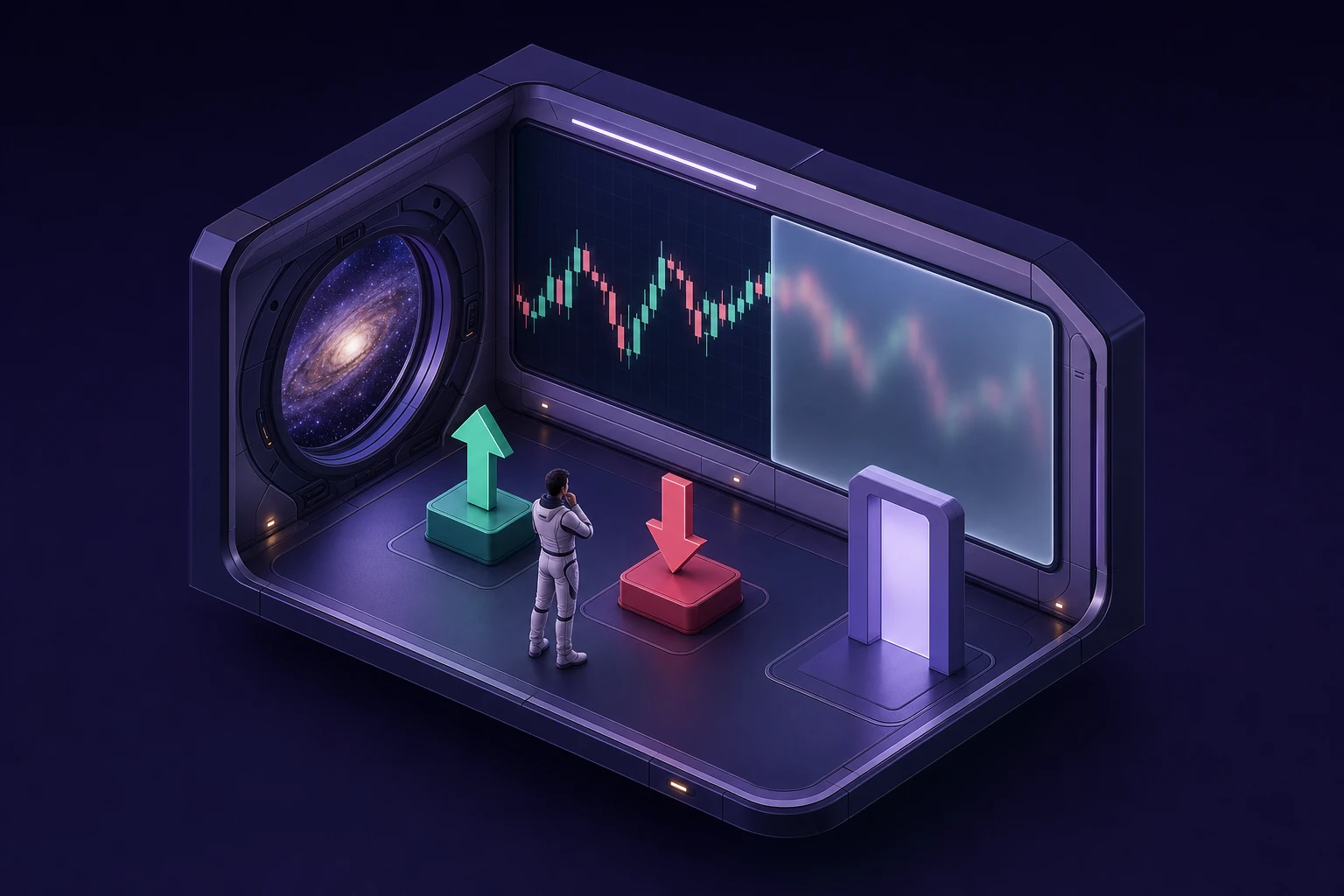
That is the idea behind TradaZen. The app shows you a real past chart, at a real date, with what came next hidden. You choose Long, Short, or "I stay out", then the market reveals what it did, on a simulated balance. You can also keep your journal in the app. For details, read the page on the trading simulator or try a few trading exercises.
A simulator has its limits. It does not fully reproduce the emotion of real money, and a good read on a past chart says nothing about a future result. TradaZen places no orders, does not manage your money and gives no investment advice.
Frequently asked questions
What percentage of traders lose money?
According to the study published in 2014 by the AMF, the French market regulator, 89.4% of 14,799 active retail clients trading Forex and CFDs in France lost money over four years. ESMA, for its part, cites a range of 74 to 89% of losing CFD accounts in the European Union.
Why do so many people lose money trading CFDs?
The AMF measured three factors: the more orders a client places, the larger those orders, and the greater their total exposure, the bigger their loss. CFD leverage amplifies each of these factors.
Do experienced traders lose less?
Not in the AMF study. Among the 1,881 clients active every year, the share of losers rose from 82.51% in the first year to 87.56% over four years, and their average loss grew. The AMF describes this as an absence of any learning effect.
Do costs explain the losses?
Only partly. The financing costs and commissions measured by the AMF account for 14.2% of client losses. The rest comes from the trades themselves. Spreads could not be measured.
 Mehdi Azizi created TradaZen and published it on the App Store through the Devoria studio. The app's scenarios are real past charts, never made-up data.
TradaZen is a training tool: you play on past market data with a simulated balance. It is not a broker and not investment advice. Real trading carries a risk of capital loss.