 TradaZen
In 20 seconds
- Shape
- A near-zero body: the open and close land at almost the same price.
- Where
- Anywhere, but it can only be read alongside the preceding trend and the surrounding levels.
- What it tells you
- Hesitation: neither side won the period. Not a direction.
- Confirmation
- The next candle closes beyond the doji. Over five years of Bitcoin, even confirmed, it did no better than any other candle.
- Invalidation
- Price moves past the tip of the wick opposite to your trade's direction.
The doji is the candle of hesitation. Price moved during the period, sometimes a lot, but it finished where it started. Neither buyers nor sellers took the upper hand.
Many websites present it as the sign of a coming reversal. Over five years of Bitcoin, that is not what the numbers show. The doji deserves your attention, but for a different reason: it tells you to look at the context before you decide.
This guide describes a training method, not investment advice. Trading carries a high risk of capital loss.
Spotting it
A candle has an open, a close, a high and a low. The body connects the open to the close. On a doji, that body is so thin it looks like a line: the two prices are almost equal.
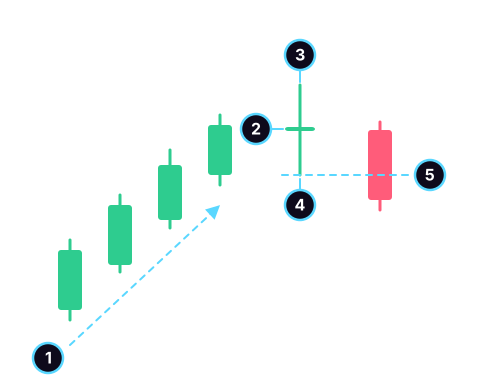
- The preceding trend, here an uptrend.
- The body: the open and the close at almost the same price.
- The upper wick: the highest price reached during the period.
- The lower wick: the lowest price reached.
- The confirmation: the next candle closes below the doji's low. After a downtrend, it would close above its high.
There is no official threshold for calling a body "almost nonexistent." The measurement below uses a body of at most 10% of the candle, from high to low. Keep the same rule every time you read a chart, or you will see dojis everywhere.
The four dojis, and the spinning top
Where the body sits on the wick gives the doji its name. A fifth candle looks like one without being one.
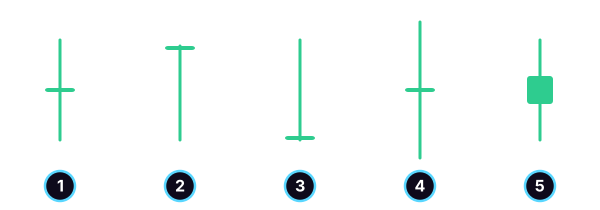
- The standard doji, cross-shaped: two wicks of similar length.
- The dragonfly doji: body at the top, a long lower wick. Sellers pushed, buyers took it all back. It resembles a hammer with no body.
- The gravestone doji: body at the bottom, a long upper wick. The opposite: buyers pushed, sellers took it all back.
- The long-legged doji: two very long wicks. The widest hesitation.
- The spinning top: a small body, but a real body. It is not a doji, even though it also signals hesitation.
What 5 years of Bitcoin show
I counted every doji over five years of Bitcoin, after a downtrend and after an uptrend. The question: did price then move the other way more often than after any other candle in the same situation?
Reversal here means: price higher six or twelve candles later after a downtrend, lower after an uptrend.
| After… | Cases | Reversal at 6 candles | Reversal at 12 candles |
|---|---|---|---|
| a doji, after a downtrend | 531 | 49.9% | 50.8% |
| any downtrend candle (baseline) | 4,500 | 54.2% | 53.3% |
| a confirmed doji, after a downtrend | 120 | 46.7% | 50.8% |
| a doji, after an uptrend | 577 | 52.9% | 47.3% |
| any uptrend candle (baseline) | 4,798 | 51.8% | 49.6% |
| a confirmed doji, after an uptrend | 128 | 45.3% | 47.7% |
Method: BTC/USDT, 4-hour candles, public Binance data, from January 1, 2021 to December 31, 2025, for a total of 10,956 candles. Doji: body of at most 10% of the candle. Downtrend: close below the average of the last 20 closes and below the close of 10 candles earlier; uptrend: the opposite. Confirmed: the next candle closes beyond the doji, in the direction of the reversal. Past data: it does not predict the future.
The doji does not signal a reversal. After an uptrend, it performs on par with any candle. After a downtrend, it even does slightly worse, at the edge of the margin of chance. Confirmation does not help: confirmed dojis do worse than the baseline in both directions.
Nor does it signal a bigger move. Six candles after a doji, price had moved a median of 1.34%, versus 1.39% after any candle.
It is a clue, not a rule. The doji says the market hesitated. What it does next is read in the trend and in the levels around it.
Reading it methodically
- Place it in context. After which trend? On what level: a former high, a former low, or nowhere in particular?
- Wait for the close. A candle still forming can look like a doji for hours, then finish with a real body.
- Look at the next candle. It tells you which way the hesitation was resolved. The numbers show it still isn't enough to make a signal.
- If you enter, place your stop beyond the tip of the opposite wick: that is where your reading becomes wrong.
- Aim for at least twice your risk, or pass. The calculation is in the guide on the risk/reward ratio.
- Write your decision in your journal, even when you don't enter.
After a doji, staying out is often the most reasonable choice, and it is a decision in its own right.
Common mistakes
- Treating the doji as a reversal signal: the numbers don't support it.
- Reading it in isolation, without looking at the trend or the levels around it.
- Confusing a doji with a spinning top: the spinning top has a real body, however small.
- Hunting for dojis on the 1-minute chart: on very short candles, many dojis are just noise.
Practice reading hesitation
In TradaZen, the "The candle" unit asks you the question on real charts: "The body of the last candle: decisive or hesitant?" You answer, then the app shows you how much of the candle the body takes up.
In Training, you read a real chart at a real date, with what came next hidden. You choose Long, Short or "I stay out," then the market reveals what it did, on a Simulated balance. To learn more, read the page on the trading simulator.
For other patterns, see also bullish and bearish engulfing and the morning star and evening star, whose middle candle is sometimes a doji.
Your turn
Read real candles, just like in the app.
The same exercise as the "The candle" practice in the app, on real candles. What comes next is hidden.
Loading the exercise…
Charts: TradingView Lightweight Charts
Frequently asked questions
What does a doji mean in trading?
A doji means the open and close of the period are at almost the same price. The market moved, then came back to where it started: neither side won the period. It is hesitation, not direction.
Does a doji signal a reversal?
Not on its own. Over five years of Bitcoin on 4-hour candles, price moved the other way after a doji about as often as, or slightly less often than, after any candle. Even when confirmed by the next candle, it did no better.
What is the difference between a doji and a spinning top?
A doji has almost no body: the open and close merge. A spinning top has a small visible body, with wicks longer than the body. Both signal hesitation, but only the first is a doji.
Dragonfly or gravestone doji: which one is bullish?
Neither is a signal in itself. The dragonfly doji shows a rejection of lower prices, the gravestone a rejection of higher prices. What they mean depends on the preceding trend and the level where they appear.
 Mehdi Azizi created TradaZen and published it on the App Store through the Devoria studio. The app's scenarios are real past charts, never made-up data.
TradaZen is a training tool: you play on past market data with a simulated balance. It is not a broker and not investment advice. Real trading carries a risk of capital loss.