 TradaZen
In 20 seconds
- Is it possible?
- The basics, yes: they are public and free. The time and the discipline are up to you.
- The numbers
- AMF, 2014: 89.4% of clients losing over four years, and no measurable learning effect.
- The path
- Chart, candlesticks, risk, practice on past charts, journal. In that order.
- Avoid
- Courses that promise income, paid signals, trading bots.
- Before real money
- Dozens of decisions measured in R, on a simulated balance, and a written plan.
You can learn the basics of trading on your own. Books, the educational pages of regulators and the charts themselves are open to everyone. Two things can't be learned by reading: deciding without knowing what comes next, and sticking to your rules after three losses in a row.
This guide gives you a five-step path, in the order where each step builds on the one before. It starts with the numbers, because they show what learning does not do.
This guide describes a training method, not investment advice. Trading carries a high risk of capital loss.
What the numbers say before you start
In 2014, the Autorité des marchés financiers (AMF), the French market regulator, published a study of retail investors' results trading CFDs and Forex. It covers four years and 14,799 active clients. It also tracked separately 1,881 clients who were active every year, the most regular ones.
| AMF finding (2014) | Figure |
|---|---|
| Active clients studied | 14,799 |
| Losing over four years | 89.4% |
| Median result per client | −€1,843 |
| Regular clients losing, year 1 | 82.51% |
| Regular clients losing, over 4 years | 87.56% |
| Average loss, year 1 | −€4,989 |
| Average loss, over 4 years | −€26,745 |
The clients who kept going did no better. The share of losing clients grew over the years, and so did the average loss. The AMF concluded that there was no learning effect. In 2018, the European Securities and Markets Authority restricted the sale of CFDs to retail clients, citing 74 to 89% of losing accounts according to national regulators.
Experience alone taught the clients in the study nothing. Measured practice, with written rules and a journal you reread, at least has a chance to. The guide why traders lose details the measured causes.
The five-step path
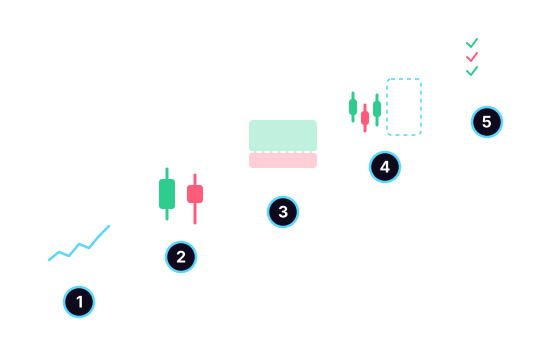
- Reading a chart: price, time, timeframe.
- Candlesticks: open, close, high, low.
- Risk: the stop, position size, the ratio between stop and target.
- Practicing on past charts, with what comes next hidden.
- The journal, reread every week.
1. Reading a chart
Pick a single market and look at it every day on the daily chart, then on the 4-hour chart. Note whether it is rising, falling or going sideways, and where the latest lows and highs are. The guide how to read a stock chart starts from scratch. You move on when you can say, on a chart you've never seen, what the price did and over what period.
2. Candlesticks
A candlestick sums up a period in four prices. Its size, its wick and its place in the move show how buyers and sellers behaved. Start with Japanese candlesticks, then the doji and the hammer. Learn patterns to read, not to predict: over five years of Bitcoin on the 4-hour chart, neither the hammer, nor the doji, nor the engulfing pattern did better than a random candlestick in the same situation.
3. Risk
This is the step that protects your account. Learn to place a stop loss where your idea becomes wrong, to calculate your size with the 1% rule, and to check the risk/reward ratio before you enter. Also read the guide on leverage before using any. You move on when you can calculate a position size without hesitating.
4. Practicing on past charts
Reading guides doesn't train you to decide. Take a past chart, hide the right side, and decide: buy, sell or nothing. Set your stop and your target, then reveal what came next. Record the result in R, that is, in multiples of the risk taken. Judge yourself on several dozen decisions in the same market, not on one. The page on trading exercises describes three exercises you can do today.
5. The journal
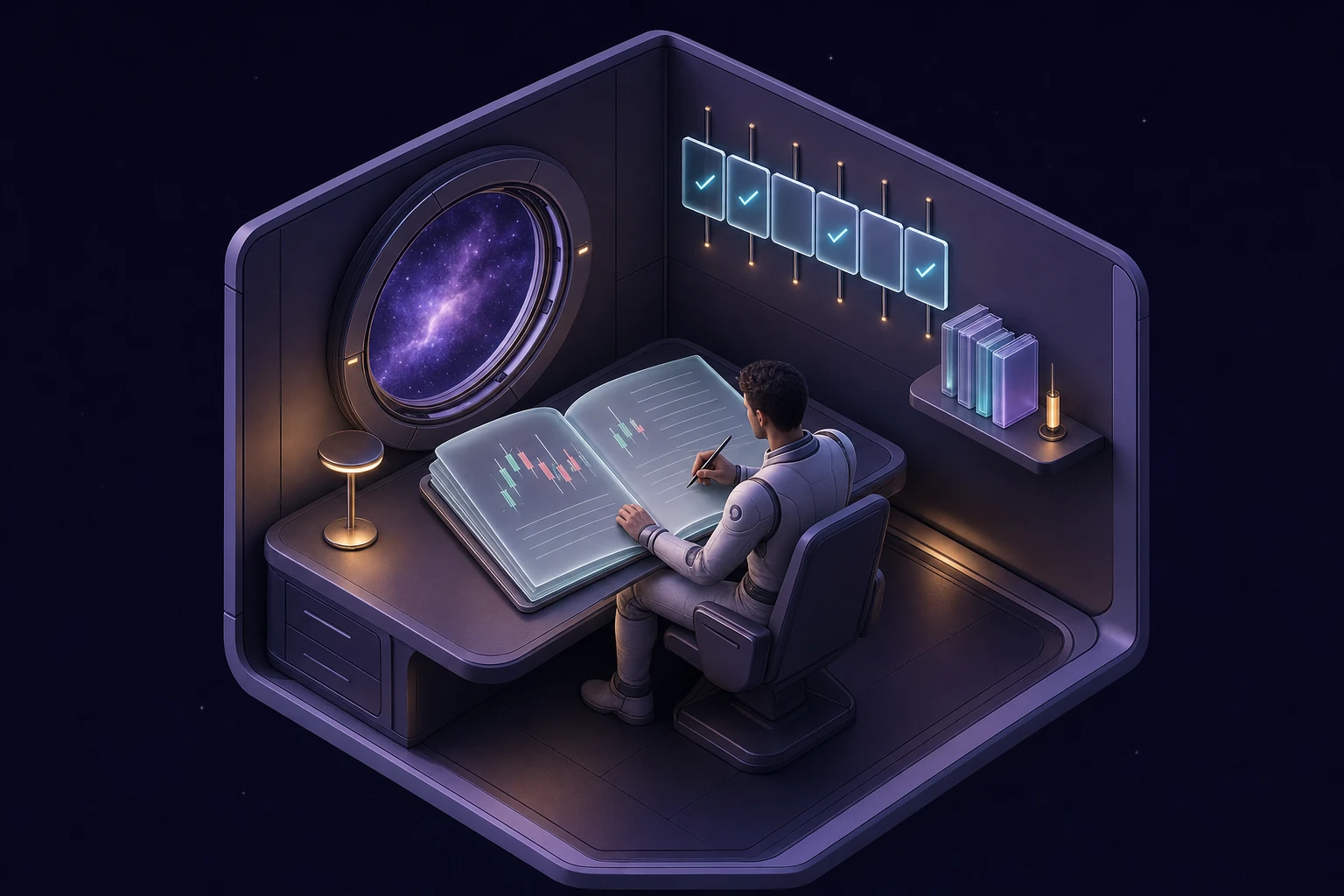
After each decision, answer three questions: were you following your plan, what was your reason for entering, did you respect your exit? Reread everything every week. The method is detailed on the trading journal page. The journal leads to the trading plan: one page of rules written before the session.
What to avoid
- Courses that promise income. In June 2020, the AMF warned against pyramid schemes selling trading course packs for a few hundred euros, sometimes with a monthly subscription. Buyers then had to recruit other buyers. The AMF points out that "you don't become a trader in a few hours."
- Trading bots. In March 2023, the AMF warned about bots sold under license, with unrealistic returns, promoted in closed messaging groups and linked to a broker not authorized in France.
- Paid signals. Someone sells you entries to copy. You can't verify their real track record, and you learn nothing: the day the signals stop, you're no better at deciding than before.
- Screenshots of gains. An account shown in an image says nothing about the losing accounts nobody shows.
- Leverage from day one. It multiplies every learning mistake.
- Changing methods every week. No rule can be judged on five trades.
Before paying anyone, check that the company is authorized and that it isn't on the AMF blacklists. Never risk money you need.
Common mistakes
- Learning patterns before risk. A good read with a position size that's too big still costs you the account.
- Judging a decision by its result. A winning entry taken for no reason teaches you no more than a losing entry taken for a good reason.
- Keeping no record. Without a journal, your memory keeps the spectacular trade and forgets the small slips.
- Switching to real money to "really" learn. Mistakes are expensive there, and the AMF study shows they don't go away with time.
Practicing alone, but with a measure
TradaZen is built for step 4, and its lessons cover steps 2, 3 and 5. A path takes you from candlesticks to decisions: Nova, the app's astronaut, explains charts with zooms and annotations, and each concept is applied right away on real scenarios. Among the units: "The candlestick," "Managing your risk," "Position size" and "The plan and the journal."
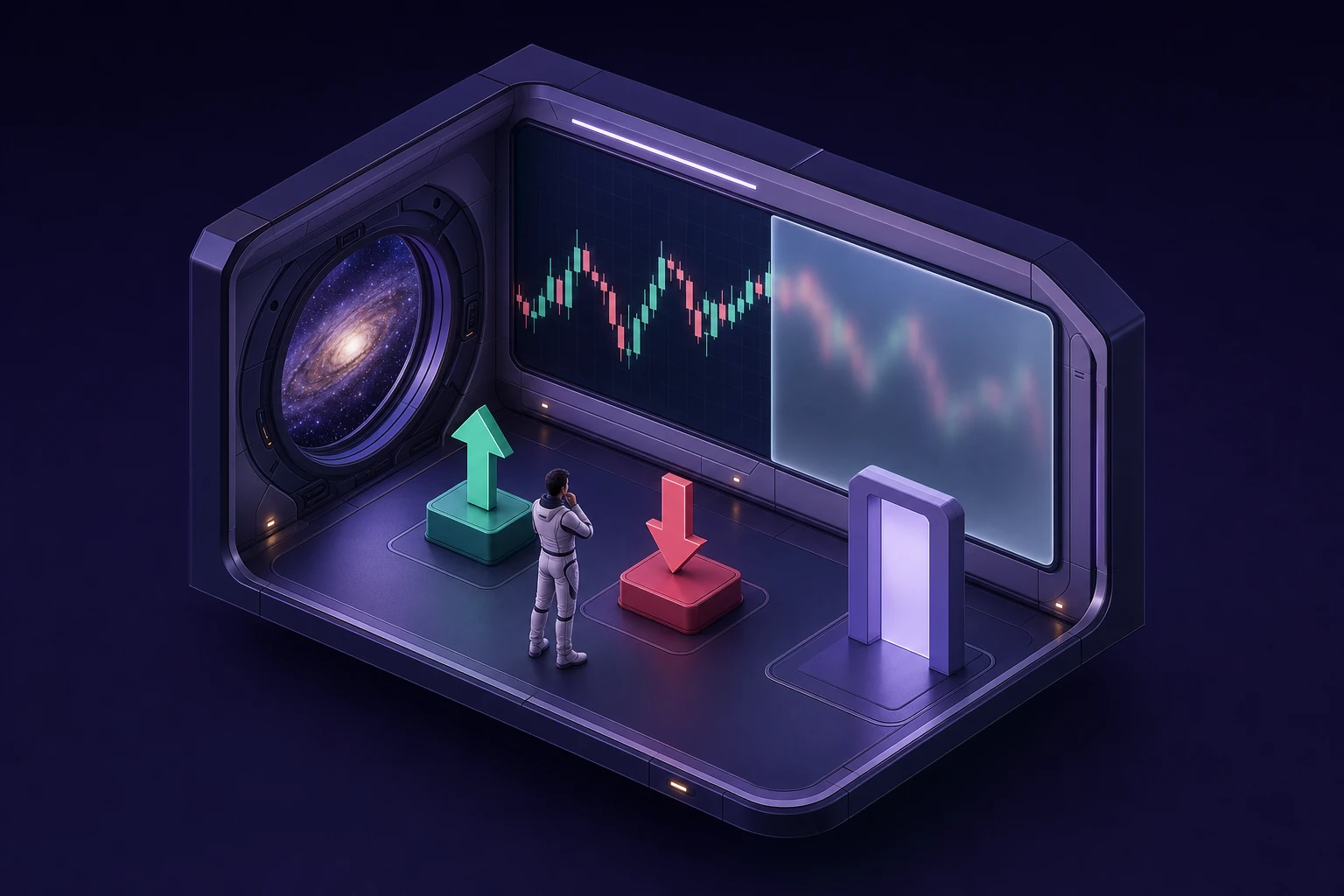
In Training, you read a real chart at a real date, with what comes next hidden. You choose Long, Short or "I stay out," the app sets the Stop and the Target, then the market reveals what it did, on a simulated balance. Your stats track your Accuracy, your Mean R and your Streaks, and a Journal complements the training. For details, read the page on the trading simulator.
A simulator has its limits. It doesn't fully reproduce the emotion of real money, and a good read on a past chart says nothing about a future result. TradaZen places no orders, doesn't manage your money and gives no investment advice.
Frequently asked questions
Can you learn trading on your own?
Yes, for the basics: reading a chart, understanding candlesticks, calculating your risk, practicing on past charts and keeping a journal. But learning guarantees no result. According to the AMF, the French market regulator, 89.4% of retail clients active on Forex and CFDs lost money over four years.
How long does it take to learn trading?
No length of time guarantees anything. Count in decisions instead: several dozen decisions recorded in R in the same market, with a stop set every time, before judging your reading. Even then, real trading still carries a high risk of capital loss.
Do you need to pay for a course to learn trading?
No, the basics are public. If you do pay, steer clear of any offer that promises income, asks you to recruit other buyers or sells signals to copy, and check the company against the AMF blacklists.
Can you learn trading for free?
Yes: the guides on this site, a free chart and a notebook are enough for all five steps. TradaZen's exercises, on the other hand, require the TradaZen Pro subscription, with 7 days free on the annual plan for eligible new subscribers.
How much money do you need to start trading?
To learn, none: a simulated balance is enough. For real trading, no amount is "the right one." Never put in money you need, and assume you can lose all of it.
 Mehdi Azizi created TradaZen and published it on the App Store through the Devoria studio. The app's scenarios are real past charts, never made-up data.
TradaZen is a training tool: you play on past market data with a simulated balance. It is not a broker and not investment advice. Real trading carries a risk of capital loss.